How to Stop Towels From Shedding: Lint, Fuzz and Pilling
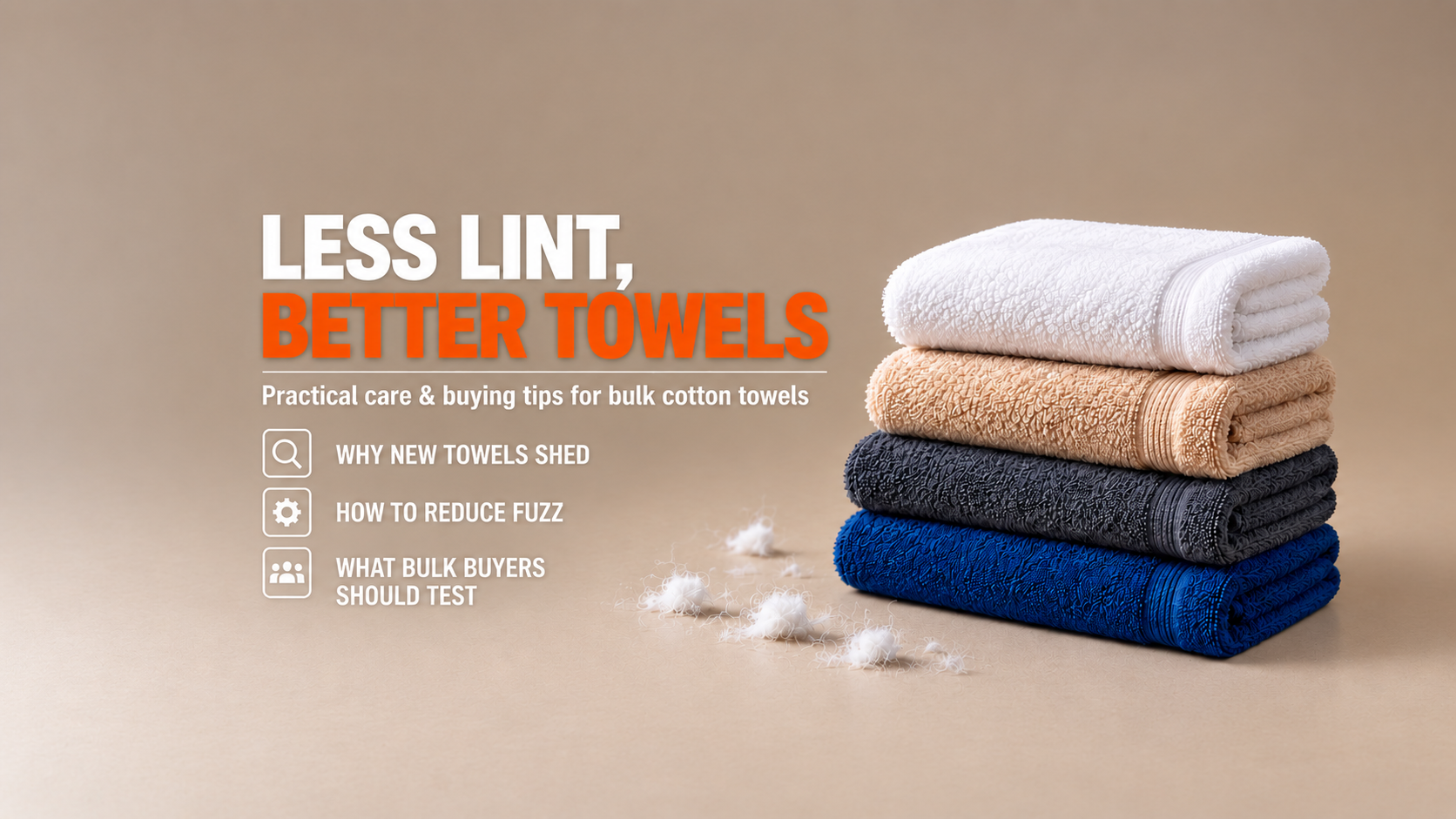
It can be very frustrating to towel dry your body only to get fluff on yourself due to shedding, but this is not an indication that there is something wrong. Towels made of cotton have fibers that are not tightly bound at the time they come out of the factory, and this is washed away during the first few washes.
If there’s still heavy lint after five or six washes, the problem is the towel or the laundry routine. We sell wholesale towels by the dozen to hotels, gyms, salons and spas, so there’s also a section on testing a new case before it goes into service.
Why do cotton towels shed?
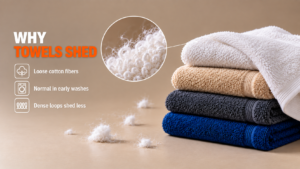
Cotton towels shed because terry cloth is built from short fibers, and some of them work loose. Terry, the fabric most bath towels are made from, is thousands of small cotton loops on a woven base. Each loop of fabric is made of yarn, which is made of short strands twisted together. If the strand is not held tight, washing and abrasion will pull the strand away, leaving it to end up on you, in the lint trap, or on your black tights.
Why are my new towels shedding?
Most of the time, new towels shedding lint are just getting rid of fiber fragments left in the pile at the mill. Many also come with a silicone softener finish that makes them feel plush in the store but holds loose lint in place until it washes off. So the first couple of washes do most of the work.
Fiber length, yarn and loop density
Long cotton fibers are twisted into the yarn many times along their length, so they’re hard to pull out. Short ones have less to grip. Combed cotton has many of the short fibers stripped out before spinning, which is why combed and long-staple towels (Egyptian cotton, Pima cotton) usually settle down faster. Cheap towels labeled “Egyptian cotton” deserve some suspicion. Dense loops help too. Wholesale towels are sold by weight in pounds per dozen, and at the same size, a heavier dozen usually means a denser pile that sheds less. Our towel weight guide explains how to read those numbers.
Washing and drying habits
Heat and friction causes fiber separation, hence stuffed washers, high temperatures in dryers, and loads with lots of zippers contribute to faster shedding. So does chlorine bleach since it wears out cotton gradually. Most salons bleaching colored towels change to bleach-resistant towels which are stained to maintain their color.
Why does my towel leave lint on my skin?
New towels leave lint on skin for a simple reason: wet skin picks up anything loose. You’ll notice it most with new bath towels shedding lint after a shower, since they cover the most skin. New hand towels do it too, usually on your face. Patting dry instead of rubbing helps.
Color mostly changes how visible it is. Navy or black bath towels aren’t necessarily shedding more than white ones; dark lint just stands out on skin and white tile.
New towels leaving fuzz on your body is normal as long as there’s less of it after each wash.
Is towel shedding normal?
For a new towel, yes. A towel shedding fuzz for its first few washes is just breaking in. Watch whether the lint drops from one wash to the next.
| Usually normal | Worth a closer look |
| The towel is new (first few washes) | Heavy shedding after 5 or 6 washes |
| Some lint in the dryer lint screen | The lint screen fills up with every load |
| A little fuzz on your skin | The towel looks thinner, or you can see the base weave |
| Less lint each wash | The same amount of lint, or more |
| Loops are intact | Pulled loops, bald patches, frayed edges |
How to stop towels from shedding in the first few washes
If you want to stop new towels from shedding lint, most of the fix happens in the first few loads. These six steps are how to wash new towels to stop shedding, and they work for every towel in a set.
1. Wash before first use
Wash new towels before anyone uses them, including washcloths that go straight onto faces. The first wash strips the factory finish and flushes out a lot of loose fiber. Older advice says to freeze new towels or soak them for a day first, but there’s no good evidence either beats a normal wash.

2. Wash them alone, with room to move
New towels drop lint on everything, especially dark clothes and fleece. The simplest way to stop towel lint from ending up on your clothes is to wash towels only with other towels for the first three or four loads. Don’t pack the drum, either. Towels need space so the water can carry loose fibers away.
3. Use less detergent and skip fabric softener
Extra detergent doesn’t rinse out of thick terry, and the residue holds lint in place. Use the normal-load amount or a little under. Leave out fabric softener too, since it coats the fibers and traps lint in the loops. Our towel washing tips cover the rest of a regular routine.
4. Dry on medium heat
High heat makes cotton brittle, and brittle fibers break. Use medium heat and take towels out once they’re dry. Line drying outside works too, and a breeze carries off some of the loose lint.
5. Shake them out and clean the lint screen
Shake each towel hard before and after drying to knock surface lint loose. Then clean the lint screen, because a full one sends lint back onto the towels. It’s also a fire risk, especially in commercial laundry where dryers run all day.
6. Keep zippers and hooks out
Zippers, Velcro, bra hooks and denim rivets catch terry loops and pull them, and pulled loops shed and pill. In a gym laundry room where gym towels go in with everything else, someone has to make that a rule.
Does vinegar stop towels from shedding?
By itself, it does not do much, but it can make it faster. Add half a cup to a full cup of white vinegar in the rinsing cycle and it will dissolve the detergent and factory treatment and allow fibers to be washed away in the washer rather than on you. It will not help reattach fibers or mend an old towel. No matter what you put in your washer, there is no stopping cotton shedding.
Safety note: Never add vinegar to a load with chlorine bleach in it. Mixing the two releases chlorine gas. Salons bleach towels often, so this matters most there. For more on salon laundry, see our guide to washing salon towels without fading.
How to get lint off new towels
To remove lint from new towels, go in this order:
- Shake each towel hard after washing and after drying.
- Put dry towels back in the dryer for 10 minutes on no heat, with a clean lint screen.
- Use a lint roller to remove fuzz from new towels once they’re out of the dryer.
- Take pills off with a fabric shaver or pilling brush, lightly.
- Snip pulled loops level with the pile. Pulling them can bring the next loop out too.
Why is my towel still shedding after washing?
When you have a towel shedding lint heavily after five or six washes, it’s usually one of these:
- The towel is made from short-staple cotton in loosely spun yarn, which sheds for as long as you own it.
- The dryer runs too hot, or loads are packed too tight.
- The towel is old. An old towel shedding fluff has loops that are breaking down, which usually means it’s time to replace it.
- Hard water minerals or leftover detergent have built up. Hard water is common across much of the US, as the USGS water hardness map shows. An occasional stripping wash with hot water, washing soda or borax and a thorough rinse clears it out.
- If every set of towels you own sheds, check the washer drum for rough spots or burrs.
How many washes until towels stop shedding?
Three to five, for most new cotton towels. Heavier towels often settle sooner and light, loosely looped ones take longer. Rather than counting, check the lint screen. If the lint hasn’t dropped by the fifth or sixth wash, more washing probably won’t fix it.
Towel lint vs. pilling: what’s the difference?
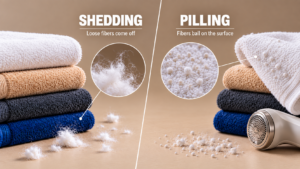
The difference is where the fibers end up. Towels shedding lint lose them completely. Towels that pill keep them on the surface, tangled into little balls. Shedding fades with washing. Pilling comes from friction, and the pills have to be removed with a shaver or brush.
| Shedding (linting) | Pilling | |
| What happens | Fibers come off the towel | Loose fibers tangle into small balls that stay attached |
| Where you see it | On skin, clothes, the dryer lint screen | On the towel’s surface |
| Most common with | New towels | Worn towels, or towels washed with rough fabrics |
| Does washing help? | Usually; it tapers off | Not much; pills have to be removed |
What causes towel pilling?
Towel pilling starts when loose fibers tangle on the surface instead of falling away, usually from rubbing in the washer and dryer. Polyester is stronger than cotton, so pills on cotton/polyester blends hang on longer.
How to stop towels from pilling
Cut the friction. Run smaller loads, keep rough fabrics out of the wash and turn the dryer heat down. Don’t pull existing pills off by hand, since that drags more fibers out of the loops.
Which towels shed less?
Combed or long-staple cotton with dense loops sheds the least, and cotton/polyester blends shed less than 100% cotton, though they’re a little less absorbent. If you’re working out how to keep towels from shedding over the long run, the towel matters as much as the wash routine. Ring-spun yarn is generally stronger than open-end yarn, which usually uses shorter fibers. Hotel buyers can find more in our hotel towel buying guide.
How Towel Super Center grades compare for shedding
Here’s how our own grades compare on lint. Our guide to which towel grade you need goes deeper on cotton types and weights.
| Grade | What’s different | Best for | What to expect |
| Economy | 100% cotton, less plush loops | Gyms that lend towels, grooming, car washes | More break-in lint. Good where cost and turnover matter more than feel. |
| Premium | Tighter loops, fluffier | Salons, gyms, hotels | Holds fibers better than Economy |
| Premium Plus | Our plushest 100% cotton | Spas, hotels, country clubs | More lint in the first washes, then it settles |
| 86/14 Blended | 86% cotton, 14% polyester | Heavy laundering and bleach | Usually our lowest-lint choice; holds up to bleach |
| Bleach Resistant | Colored, dyed to handle bleach | Salons, spas | Worth it if bleach fades your colored towels |
Managing towel shedding when you buy towels in bulk
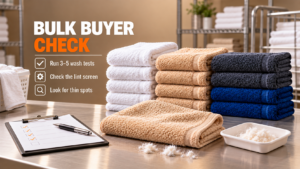
Test each new order before it goes into service. Guests notice new towels leaving lint on dark clothes, and a batch that keeps shedding wears out early.
- Run a few towels from the new case through your normal cycle, with your usual chemicals and temperatures. A home-machine test won’t tell you much if your laundry runs hotter or uses bleach.
- Check the lint screen after each of the first few cycles. The lint should drop every time.
- After three to five washes, hold towels up to a light and look for thin spots or broken loops.
- Keep enough stock to rotate. Many hotels run three sets of hotel towels per room: one in use, one in the laundry and one on the shelf.
- Match the grade to the laundering. A gym towel washed hot with bleach every day needs a different towel than a spa towel washed gently a few times a week.
If you’re switching grades, order a sample by calling 1-888-405-1244 and test it in your own laundry before buying by the case.
FAQ
Why does my towel leave fuzz on me?
Loose surface fibers cling to damp skin, which is why new towels leave fuzz on skin and older ones mostly don’t. It fades within a few washes.
How do I stop bath towels from shedding?
Wash them before first use, in their own load, with a little less detergent and no softener. Dry on medium heat.
Why do new towels shed lint?
They still hold loose fibers from manufacturing, plus a softener finish that keeps lint in the pile until the first washes strip it off.
Do new towels stop shedding?
Most do, within three to five washes. If shedding is still heavy after five or six, check the towel’s quality and your dryer heat.
Is there a towel that doesn’t shed at all?
Every cotton towel sheds a little. Microfiber towels are close to lint-free, which is why car washes use them, but they don’t feel like cotton terry.